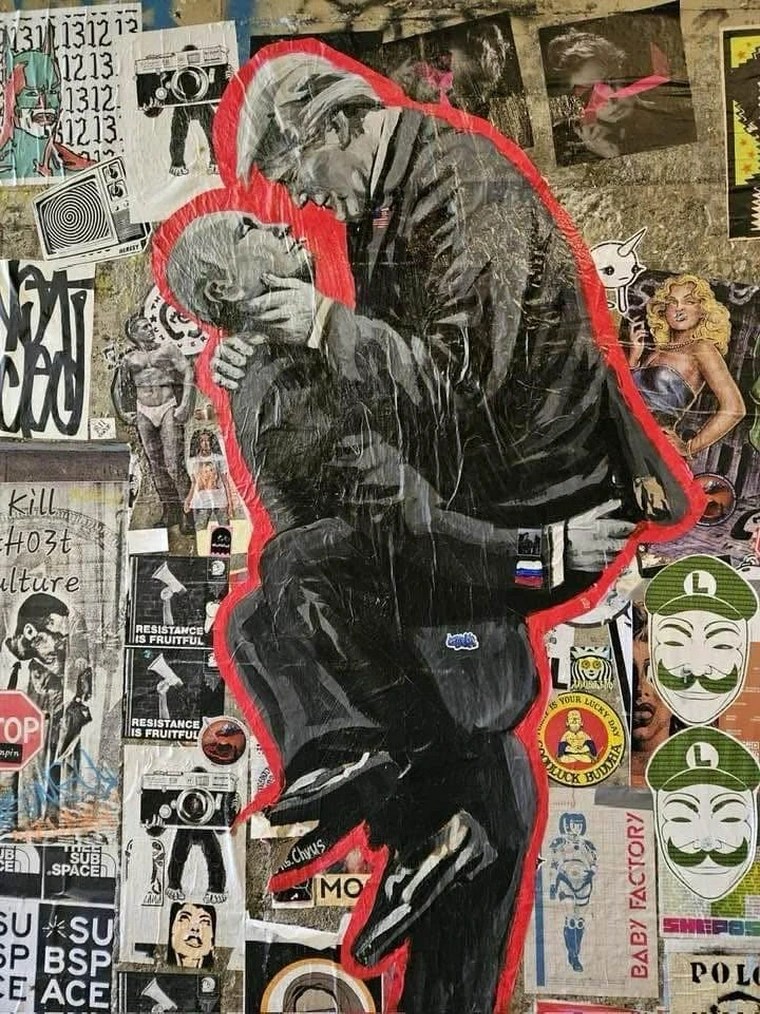
Bigly trumping the world

Today (4 March 2025) Trump put into effect his threats to withdraw military support from Ukraine and impose steep tariffs on Canada, China and potentially Mexico. Following reaction from Europe, Trump’s vice-president J.D.Vance described the UK as “some random country that hasn’t fought a war for 40 years”.  Such a derisive opinion of a supposed ally ill behoves the vice-president of a country that Ronald Reagan called a beacon of freedom.  But it’s the kind of talk from Trump and his acolytes we’ve become used to.   Trump’s recent attack in the Oval Office on the President of Ukraine demonstrated (not for the first time) that he has no interest in behaving presidentially as the leader of a democratic country. The most astonishing evidence of this was January 6th 2021, when he effectively led an assault on the US Capitol, the building that represents his system that had elected him president. Evidently, he felt a need to sabotage the political and system he formally upheld.

Such ambivalence is characteristic of a personality type that was defined at the end of the second world war by Theodore Adorno and other members of the Frankfurt Group of social scientists.  Their groundbreaking work The Authoritarian Personality (1950) – along with works by associates such as Erich Fromm’s (1942) Fear of Freedom – was widely read during the 1950s and 1960s as the world tried to understand the horrors of fascism: Hitler, Nazism, and the Holocaust.  Adorno and his mainly Jewish colleagues argued that people whose dynamism and initiative are thwarted by familial, social and economic experience may develop a personality fixated on power.  This authoritarian/fascist personality displays both sadistic and masochistic traits: both the desire for conquest and control and the desire to submit.  

By all accounts, Trump’s father was a dangerous role-model who displayed contempt for “weakness” in his personal and business affairs.   He bullied and exploited business partners, employees and tenants, especially people of colour and other “minorities”.  Trump himself suffered and learned from this cruelty.  He survived by providing himself with the brittle assurance and confidence his father exhibited.  His speeches are loaded with repeated claims of achievement: he is a very stable genius who recruits the best people and has the highest ratings.   He has learned to lie so naturally that he has almost convinced himself. His mythically “successful” career has been built on terrorising others. His hold over the men who form the majority gender in the Congress Republican Party, not to mention the millions who form his base, derives from their parallel pathology: their desire to be, and to be led by, a “strong man”.   J.D.Vance, who joined Trump in bullying Zelensky, is an example.   These traits are redolent of the masculinity cult of Andrew Tate. 

Lie and bluster as he will, Trump’s deeper desire for the support his father denied him is unabated.  There is much speculation about Putin’s hold over Trump, but, whatever the history, Putin is clearly Trump’s father-figure: distant and cruel like his father, but possessed of enviable power.  The danger of the current situation is that Trump’s pathology transcends other loyalties and boundaries.  He has often stated his contempt for soldiers and others who are prepared to fight and die for what they believe.  He has no belief except in power.  Like a Mafia gangster, he accused Zelensky of disrespect.  Zelensky’s courage means nothing; he is the weak player in this game, and must be abandoned if he will not allow Ukraine to be exploited by the US and Russia.  In Trump’s fantasy world of power, he will become leader of an empire including Canada and Greenland, while Putin can possess Ukraine and other Baltic states.  They will be partners in ultimate global power.  

The tragedy is Trump’s and the world’s. We are all endangered by a deeply wounded and dangerous individual who should never have got anywhere near the presidency and is living out his childhood trauma at global cost. 
On Political Leadership

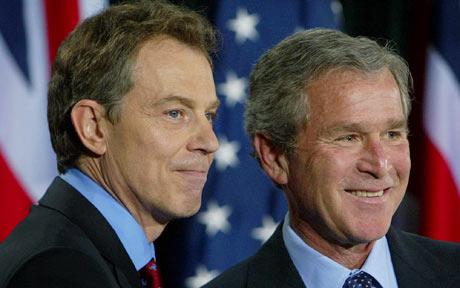
blair-bush_1706409c

Possibly the most striking and chilling phrase to come out of the Chilcot report on the circumstances of the decision to invade Saddam Hussein’s Iraq is Tony Blair’s assurance to George Bush in July 2002: “I will be with you, whatever.”  As the Independent comments, these are like the words of a lover promising to be faithful till death us do part.  They suggest a level of emotion and relationship not often admitted between national leaders. They also indicate how the emotional needs and responses of one person might precipitate the death of thousands.

One of the best-known concepts that came out of the work of Adorno, Horkheimer and other members of the Frankfurt Group in the 1930s and 1940s, when they were trying to explain the catastrophe of Nazism, was the “authoritarian personality”. Although their work, including this concept, has been much critiqued subsequently, the Frankfurt school’s overall project of linking psychological characteristics with social movements offered original, holistic and connected thinking about the interplay of personality and power.

Adorno and Horkheimer explained the attraction of Fascism in terms of its providing psychic satisfactions for both leaders and followers. Put simply, leaders gained a sense of power by commanding a mass following, while followers gained a sense of security from their obedience. But the key concept was that these characteristics – of dominance and subservience – existed in everybody and were mobilised by particular social conditions. Hitler came to power as a result of the hopelessness engendered by the economic collapse of the early 1930s. The Nazi movement allowed the “masses” (as Hitler repeatedly called them in his autobiography Mein Kampf) to gain confidence from the direction of a “strong” leader, and also provided many opportunities for officers to exercise their own cruelty and dominance, most obviously over the despised “other”, Jewish people.

When Tony Blair pledged himself to George Bush, he was gaining both security and power.  He was stepping onto the world stage of military intervention as the companion of a man whose country had (as Blair has said in his recent statement) 95% of the assets required to go to war in Iraq.  He followed Bush, but, as the Chilcot report reveals, he was not merely pulled along by events.  In the UK, he pursued his desire for power single-mindedly, manipulating both his Cabinet and Parliament and, through his performance as a charismatic speaker and with the support of much of the media, the people also. It was only when the deception involved in going to war and the disastrous consequences of the enterprise became clear that the charisma of Blair faded.

Today, the day after the publication of the Chilcot report, the current leader of the Labour Party is criticised in the media for not using the Chilcot revelations to launch a swingeing attack on Blair. He is also, of course, more widely criticised for his supposed incapacity to unite the Labour Party and secure sufficient votes to defeat the current government in the next election.  Jeremy Corbyn is a very different person from Tony Blair. In March 2003, he demonstrated outside Parliament with 2 million others to protest the imminent invasion of Iraq.  He addressed the crowd competently, but, then as now, the inspiration that he gives his many followers derives from what he says rather than from the way he says it.  He is constantly criticised in the press and by members of the Parliamentary Labour Party for lacking the capacity for leadership – although the Labour Party now has more members, many of whom have joined because of Corbyn’s unwavering socialist principles, than ever before. In part, at least, this supposed incapacity for leadership derives from his refusal to personalise politics in the way that is common in most political discourse.

Perhaps Corbyn will not succeed in attracting sufficient voters in a general election to unseat the current government, split and chaotic though it is. But he is modelling a new kind of politics and a new kind of leadership where authenticity and principle replace charisma and deceit.  It would be good to think that people might follow him because of his policies and values rather than for the irrational motives of the authoritarian personality.