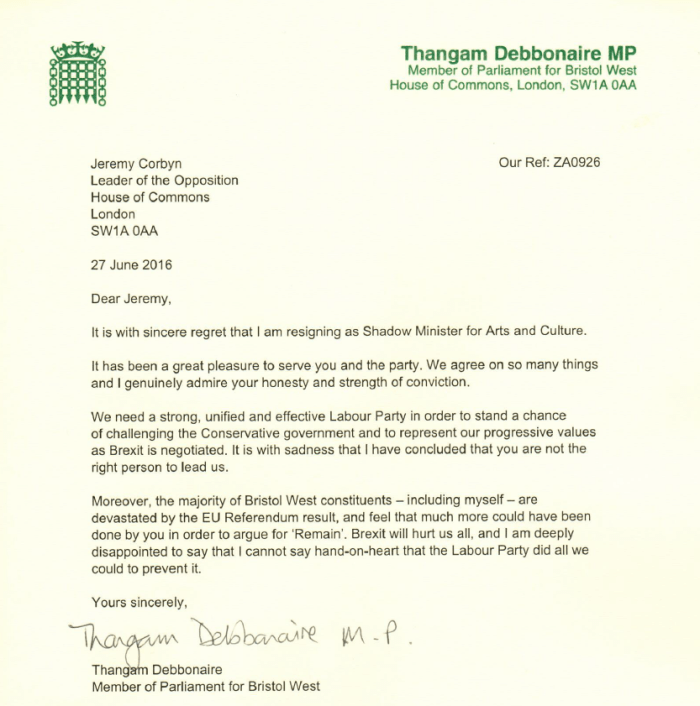
Open letter to Thangam Debbonaire

Thangam_Debbonaire_resignation_letter

27 June 2016

Dear Thangam,

I am very disappointed to read that you have resigned as Shadow Minister for Arts and Culture.

This morning, I was considering whether to travel to London to stand with supporters of Jeremy Corbyn outside Parliament while the PLP discuss the leadership this evening. I tried to find some information about supportive events in Bristol, but could find nothing on the web. Perhaps your resignation is one reason why.

One of the reasons Jeremy was elected leader of the party is that he does not dissimulate.   It is difficult for any thinking person to be wholeheartedly in favour of the EU.   It is especially difficult for the leader of a party that has a long tradition of scepticism towards the EU and that contains a vocal group that argues cogently that leaving the EU is necessary to combat the neoliberal agenda.

The concern about Jeremy’s leadership that has been expressed by you and several of your colleagues focuses on his alleged failure to ignite the Europhiliac passions of the working class communities that voted for Brexit. I don’t know how anyone could have been expected to do this. I trust you don’t imagine that Labour could be led by a left-wing version of Nigel Farage. We know where the cult of personality has led Labour in recent decades.

As you say, we need a strong, unified and effective Labour Party. Jeremy Corbyn has the support of thousands of party members. I don’t think this true of any of the leaders of the other parties and it is a great pity that the PLP are not fully behind him at this critical time.   I shall travel to London this afternoon.

Yours sincerely,

John Hodgson


I don’t want my country back


A Lidl surprise.  This happened shortly after I had read Michael Rosen’s recent blog poem that deals with the idea that the ‘working class’ and ‘migrants’ are different groups and that the latter have to be kicked out so that the former can ‘get their country back’.

Discount Stores Aldi And Lidl Increase Their Popularity

Ahead of me in the checkout queue today was a 30-something white Polish (I think) man with a boy aged perhaps nine or ten. The boy was much darker skinned but I assumed they were father and son from the very un-English way way they embraced each other while conversing in a bantering manner. I thought they were speaking Polish but then heard the father say: “It’s up to you.” They were interweaving their home language with English. Meanwhile, the Eastern European checkout operator dealt with her young daughter, who was hanging around the till, by hugging her and speaking to her in English. This was a living moment of cultural integration: hopefully our future.


Birdie, Trump and Family Guy

birdie-sanders

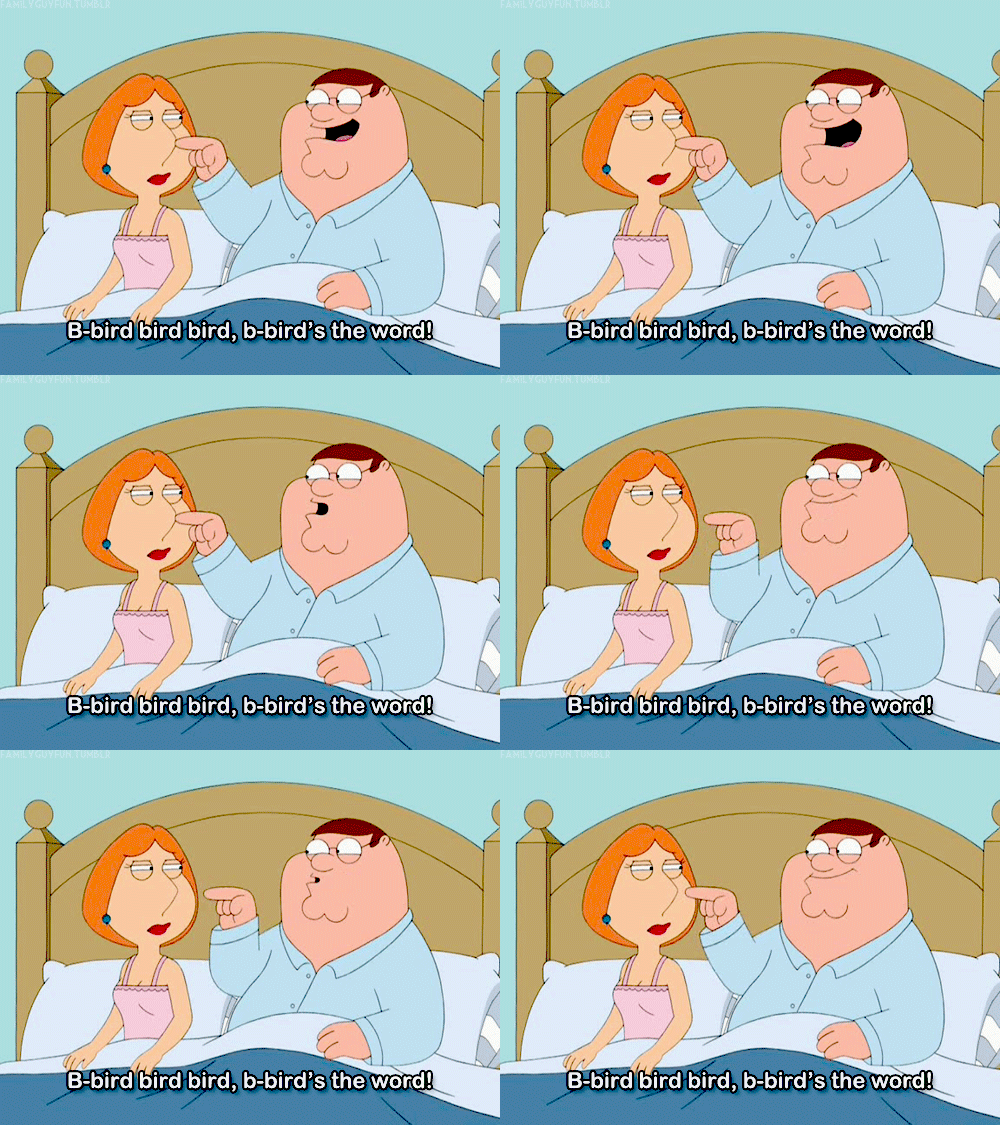
One of the videos currently doing the rounds on the internet is a pixellated animation of the Democratic nominee Bernie Sanders apparently flapping his arms like a bird, accompanied by the ‘Bird is the Word’ song from Family Guy.   Bernie’s cavorting is punctuated by captions zooming towards the viewer, like those on an old time film trailer, announcing support statistics (Idaho 78%, Utah 79%, Washington 75%). His #FeelTheBern hashtag has been complemented by #BirdieSanders. This derives, of course, from the now famous moment when a finch flew down during one of Sanders’ recent speeches and perched on the podium for some minutes. The speaker had the nous to welcome the feathered supporter and drew laughter and applause from the crowd in doing so.bird-is-the-word

In Family Guy, Peter’s incessant singing of ‘The Bird is the Word’ keeps his wife Lois awake. Bernie’s nickname and video convey a more light-hearted or positive identification with a bird. Sanders himself reminded his audience of the dove that returned to Noah with an olive branch. Be that as it may, the moniker could never be applied to the Republican nominee Donald Trump. Both Sanders and Trump are in (or approaching) their eighth decade; both derive support from members of working and middle class who cannot identify with current elite politicians. But Sanders’ appeal, unlike Trump’s, derives from policies very different from Trump’s (so far as it is possible to discern Trump’s policies).   He wants affordable college education, health care as a right rather than a privilege, a minimum wage above the poverty line and reform of campaign finance. Trump, as Henry Giroux has argued, draws on deep veins of racism and misogyny that have defaced US culture for decades. Trump Towers may reach toward the sky, but the name associates a lumbering earth-bound destructiveness.

US politics is often criticised as being inordinately focused on personalities rather than policies. In the case of Sanders and Trump, however, the policies have become signified by their supporters’ given names.   Birdie vs Trump – a clear choice for the US. birdie-president


What we could learn from Finnish education

Finnish_schoolchildren

William Doyle, an American academic, recently wrote in the Los Angeles Times about a five-month stay in Finland during which time his seven year old son attended the local primary school. His article is written in a lambent style that conveys the pleasure of the stay and of his son’s experience in what he calls “a stunningly stress-free, and stunningly good, school system”.  Aged seven, his son attended the first year of formal schooling: until then, Doyle tells us, many Finnish children are in day care and learn through play, songs, games and conversation.  Even in the primary school, the emphasis is on learning through play: Finns put into practice such cultural mantras as “Let children be children,” “The work of a child is to play,” and “Children learn best through play.”  The emotional climate of the classroom, Doyle reports, was “warm, safe, respectful and highly supportive”.

The experience of a child in a Finnish primary school seems very different from that of many children in English schools. In England, children as young as five or six encounter standardised testing (such as the so-called “Phonics Check”) and a curriculum that emphasises the development of “skills” rather than a more rounded and implicit approach to learning. They are affected, as are their parents and teachers, by a political climate that currently proposes to extend the length of the school day and to force all schools to join “academy chains”, sponsored by business, which will not be subject to local control and accountability.

A political and business takeover of school education has not been permitted in Finland.  “Our mission as adults is to protect our children from politicians,” one Finnish childhood education professor told Doyle. “We also have an ethical and moral responsibility to tell business people to stay out of our building.”  Finnish society appears to trust and admire teachers, who are required to have a master’s degree in education with specialisation in research and classroom practice.  Again, the contrast with England is striking. Teacher education within England has largely been taken away from universities and devolved to already overstretched schools. The result is a crisis of both recruitment and morale, the responsibility for which government refuses to recognise.

According to Doyle, “Finland delivers on a national public scale highly qualified, highly respected and highly professionalised teachers who conduct personalised one-on-one instruction; manageable class sizes; a rich, developmentally correct curriculum; regular physical activity; little or no low-quality standardised tests and the toxic stress and wasted time and energy that accompanies them; daily assessments by teachers; and a classroom atmosphere of safety, collaboration, warmth and respect for children as cherished individuals.”

A profound lack of “warmth and respect for children as cherished individuals” is shown in the current government obsession with the instruction and testing of formal grammar. The pioneering English teachers that attended the Dartmouth Conference in New Hampshire, 50 years ago, initiated an approach to language that respected the speech that a child brought to the classroom and worked with this to develop fluency, articulation and intelligence.  As Michael Rosen and many others have shown, English children are increasingly terrorised by the expectation to learn an intricate and incoherent formal grammar that does nothing to aid their reading, writing and general expression.  The ideological motive behind this, conscious or otherwise, is to ensure that many children will fail to gain cultural capital and remain losers within the English class system. Finnish children, by contrast, enjoy age-appropriate instruction and spend 15 minutes playing outside the classroom for every hour of the school day.  One day last November, when snow came to his part of the inland, Doyle heard a commotion outside his office window.  The school field was full of children savouring the first taste of winter amid the pine trees. A special education teacher said to him: “That is the voice of happiness.”
Black Metal Trunk

This trunk has held my life.

It brought my family’s things from India.

It took my books to university

(the car grazing the road under the weight).

It kept my 9.5 & 16mm films

in an outhouse in Bristol

until they got digitised.

Now the films are headed for YouTube immortality

and the trunk is in the council skip.

Black_metal_trunk_skip

Thanks to Terryl Bacon for photoshop work on the lower image.