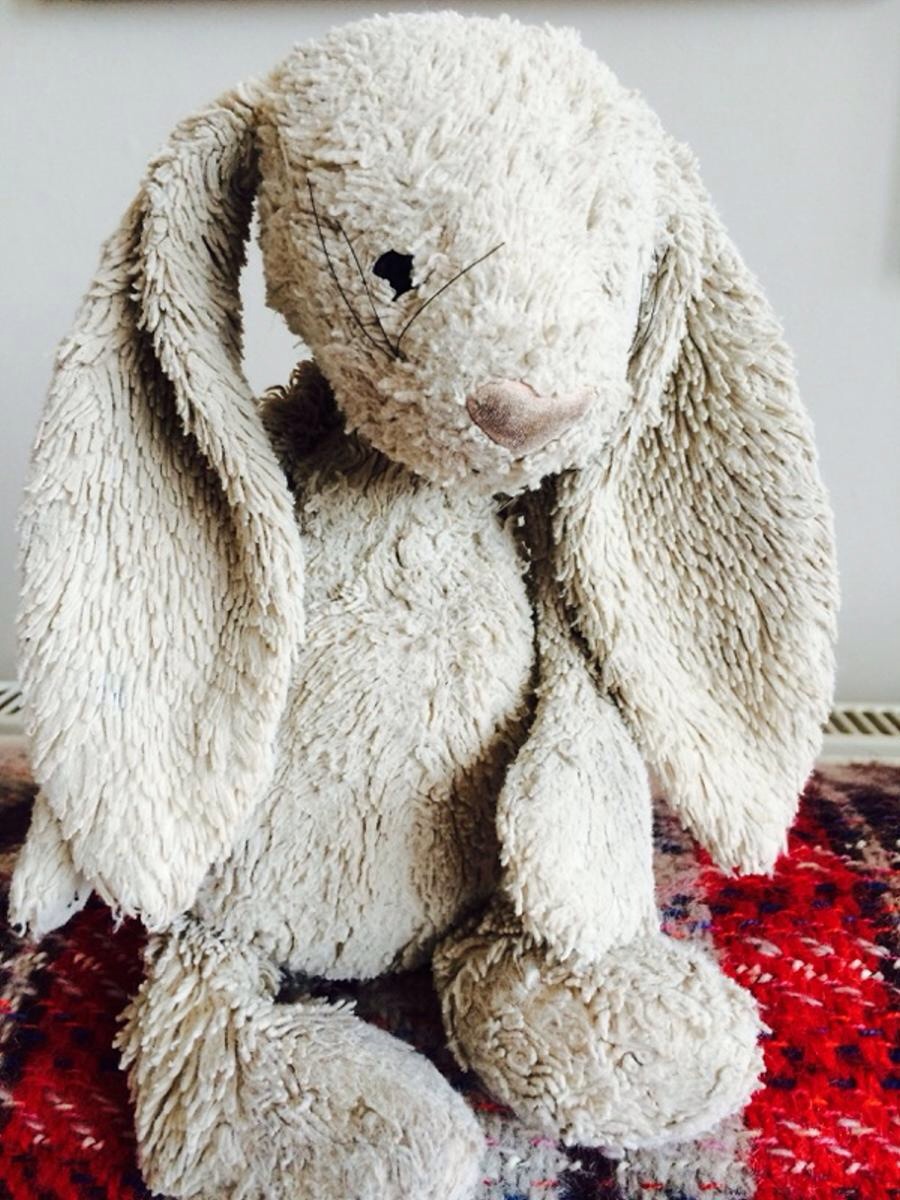
When Bibi found her lost bunny
(dirty white fur with big ears),
having missed him for six days,
she said:
‘I’ll have to get used to having him, because I was getting used to not having him.’
She missed
the presence
of absence.
When Bibi found her lost bunny
(dirty white fur with big ears),
having missed him for six days,
she said:
‘I’ll have to get used to having him, because I was getting used to not having him.’
She missed
the presence
of absence.
It’s always difficult to gauge the authenticity of people’s responses to any kind of communication. In everyday life, we get along by often saying more than we mean, in the interests of good relations, and the context of any communication has a strong bearing on its meaning. When researching the media and literacy activities of a group of adolescents I used to teach, I searched the literature of audience and reception studies, literary response, object relations psychology and other approaches to finding what my research subjects ‘really’ thought and felt. In a sense, this is an unattainable goal simply because of the multiplicity of subject-positions we can hold at any one time, not to mention the ever-present variables of context, interpersonal relations and so on.
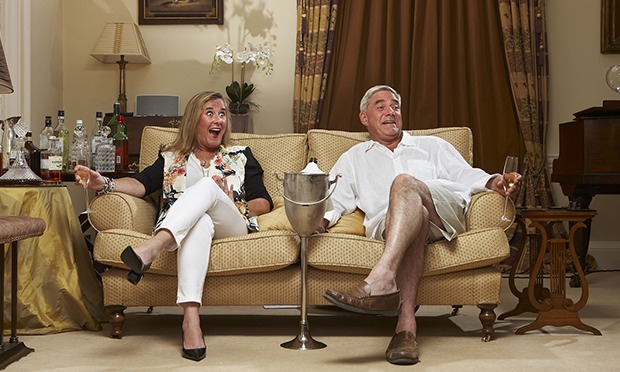
Gogglebox is a Channel 4 television programme that appears to have found a way of educing viewers’ spontaneous responses to their viewing – by observing them at home as they talk to each other about what they’re watching. Amusingly, the programme is sponsored by a sofa company. The presentation of viewing groups (usually two partners, straight or gay, or three or more family members; some groups are friends) indicates some of the ways in which the naturalness is staged and arranged. The participants are told which programmes to view, and, unlike those watching them across the country, rarely use a second screen (tablet or phone) to access social media as they watch. According to Stephanie Parker, one of the “posh pair” from Kent (pictured): “We do think out loud more than we would normally because it makes you have quite an interesting debate.” The participants may record several of their contributions to the programme on one occasion, and stories circulate about their responses being primed, although executive producer Tania Alexander insists that the reactions are absolutely real. Clearly the programme is edited down from dozens of hours of weekly video, and there must be longueurs where little is said, but, given the contrived situation, what is said feels as authentic as one can expect. Certainly it is often funny and perceptive.
In a programme broadcast shortly before the election, some of the participants were watching a Labour Party election broadcast headed by Martin Freeman, star of the Hobbit movies. Several objected to the choice of presenter, asking their companions why Ed Miliband wasn’t doing it. The male in the oldest heterosexual couple said he thought it was a good idea: the popular actor would attract viewers and give the Labour campaign a boost. But, when Freeman concluded his spiel by saying that he believed in Britain and the British people, one of the viewers exclaimed: ‘I won’t take political advice from a hobbit!’ It appears that the choice of presenter had mis-fired, or at least that he needed a different script.
Later, some of the viewers were watching the BBC Easter drama The Ark. This seems to have suffered the fate of most such dramas: portrayed naturalistically, Biblical myth usually looks merely silly. The viewers wondered why Noah (David Threlfall) had a Mancunian accent. ‘It looks like a block of flats!’ said one at his first sight of the massive ark. The messenger from God was presaged by a shadow falling across Noah. (My thought: do angels cast shadows?) The messenger was played by Ashley Walters, a former rapper jailed for gun-crime who, according to the Daily Telegraph, found religion while in prison. His new faith did not impress the viewers. ‘God wouldn’t use a rapper as a messenger!’ exclaimed one.
A documentary presenting in some detail the birth of a baby produced some para-social reactions. The father was outside the hospital making phone calls as the birth progressed. ‘Get back in there, Gary!’ shouted several of the female viewers. Fortunately, Gary did return in time to greet the purple-skinned alien who emerged to become, within seconds, a wrinkly human being. ‘We can’t have a baby!’ said one of the gay viewers to his partner. ‘No,’ the partner replied. ‘We can have a holiday.’ The same couple, discussing The Ark, wondered who came first: Noah or Jesus. This seemed an authentic reflection of modern UK secular society, although one partner was at pains to point out to the other that God came before Noah: ‘He was the Creator, he created everything!’
The programme format has been sold internationally: similar programmes are now made in China, the Ukraine, the US and Australia. According to Stephen Lambert, whose company Studio Lambert makes the series, ‘Some of the most interesting stuff has come from people watching the news.’ The participants on the programme come from a diverse social background, and anyone who wants to find out the reasons behind an unexpected election result might benefit from a trawl through the Gogglebox archives.
 I’ve started a new blog of reflections and research on the teaching and learning of English, literacy, media, communication and related subjects. This is related to my work as editor of English in Education and in research development for NATE, the UK English teachers’ association.
I’ll keep up this blog, Living in the Future Present, for creative writing and other observations.
If you’re interested, do follow my new blog at https://research1english.wordpress.com/.
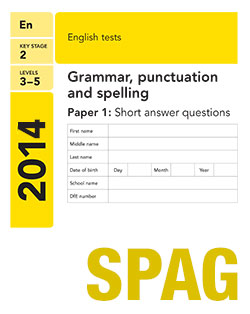 It is bad enough that children are now tested at the age of 11 on SPAG, the derogatory term used by teachers and examiners for assessment of children’s capabilities in spelling, punctuation and grammar. Any English teacher knows that a student’s attainment in these ‘skills’ (a term that requires unpacking in this context) is better tested through meaningful writing exercises rather than through decontextualised tests.
Now the situation is becoming worse, as Debra Kidd (@debrakidd)writes in her latest blog post, Testing without Brains:
<< When SATs were first introduced it was with the aim that a Level 4b would be an ‘average’ level of achievement. Very quickly this became an expected level of achievement for the majority of pupils and now it would seem that anyone falling below this (or its point score equivalent) is a failure. In order to address this failure, children will now be expected to resit the tests in Year 7. It’s a policy of such bum numbing stupidity I can barely be arsed to write. >>
Do read the rest of Debra’s post, which describes graphically how this policy will further degrade the quality of experience for pupils and teachers. What strikes me most is the ineptness of the assumption that an average attainment should become an expected attainment. This reminds me of one of the first signs of political interference in the curriculum, when GCSE was introduced in 1988. It was announced that grade F (the former CSE grade 4) would be the expected average attainment for GCSE candidates. Only in Britain, I thought, would government mark the attainment of the ‘average’ child with a grade F. Of course, expectations rapidly changed and a grade C is now regarded as a ‘pass’ for all candidates.
These attempts to constantly pressure children and their teachers on attainment (especially when the skills are poorly defined and the validity of the tests is highly questionable) need to be reviewed by an independent, non-governmental professional body. Unfortunately, there is at present no such body to act as a forum for discussion between the teaching profession and the Secretary of State for Education.
The new Southmead hospital is an airport.
There’s a shuttle bus from the car park
(Though you can walk in five minutes.)
You check in on arrival
And walk through a vast atrium to the designated gate.
There your credentials are checked and they say:
‘Oh, sorry, that clinic’s not running today.
We shouldn’t have made that appointment.
Can you come back tomorrow?’
I think they need better ground control.
I have reblogged Debra Kidd’s latest post because it gives a very clear and felt account of the reality of ‘accountability’ in present-day school education in the UK.
I’ve just spent an evening with one of my oldest friends who has just resigned from her NQT year in an inner city primary school. I encouraged her to go into teaching and now I wonder what kind of friend I was. Last year, having spent 17 years working in private business, managing teams of people and multi million pound budgets, she left to teach. She expected that she would find a working life that was more rewarding with higher aims than simply making money, which she was good at. Having seen her own children turned around with the support of a good teacher, she felt that here was a job where she could have impact and feel that there was a higher sense of purpose to her working life. And so, she took a massive drop in salary and enrolled on a PGCE.
Her PGCE was demanding with a…
View original post 677 more words

What I didn’t want for Christmas
was a spice rack.
Spices have never been my thing.
I get confused between oregano and origami.
I can’t remember when to use rosemary,
paprika, tarragon, or turmeric.
What’s the difference between cardamom and coriander?
It’s all a mystery to me.
I got a rack of spices for Christmas a few years ago.
I threw them out after years of neglect and disuse.
But this Christmas
I made bread sauce.
For the turkey.
I love bread sauce,
And this was my contribution to Christmas dinner.
I made it so carefully!
I bought ingredients.
Including spices.
Garlic, cloves, peppercorns and nutmeg.
Sprigs of thyme and a bay leaf.
It took me two hours to make on Christmas morning.
I took it to my son’s house in a large glass bowl.
It joined the other dishes on the groaning board,
Hidden behind a giant turkey and massed roast vegetables.
It was consumed without comment.
No-one said: ‘This bread sauce is beautifully spiced!’
So I explained that I’d made an effort,
Racking the shelves of Waitrose for fresh bay leaves,
Grinding nutmeg on Christmas morning.
After dinner, we opened presents.
My daughter and partner gave me a spice rack.
She said: This is just what you want, Dad!
We weren’t sure you would like it,
But after that bread sauce!
A band of jazz musicians, some retired, regularly play the Chelsea Inn in Easton, Bristol

Catching the swing, we synco-
pate into the Chelsea. The band
of six take time from years gone when:
brass resonates at front,
piano trips an autonomic rhythm,
banjo strikes arpeggio. Players retune
from lives of slower time,
set glasses dancing. Outside, Bristol
in January plays gusty wind,
debris and detritus; but in
the pub the air is clarinet
as time’s lefthanders beat the rhythm strong,
keep ragged time enhancing.
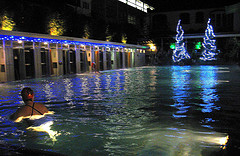
The sky is dark within the outdoor bathing pool.
Thin wraiths of steam ascend the solitary swimmers.
Swimming in January is serious. Three men, one woman
Propel themselves in lengths scooped out by hands
And arms bent right to gain dramatic traction.
Lights, blue and white, bedeck the changing roofs;
A Christmas tree is pricked with small red torches.
Double glazed diners wear cashmere sweaters
And sharp pressed trousers. Warmer by the blue-grey splash outside,
They sense their privilege. Only the swimmers toil,
Washing themselves clean of the old year,
Buoying their souls to meet the coming spring.
New Year’s Eve Dance:
Turning with the feet of time,
Reeling in the future.

 Living in the future present